
Yeasts and molds are cool… in beer and cheese.
Everywhere else, they are generally not welcome. Even if they may add a beautiful blue-green shade and a unique look to food, pet owners are not appreciative of this culinary art.
One reason is probably that, besides changing product appearance, yeasts and molds have an unfortunate tendency to alter smell, palatability, nutritional quality, and even the safety of the product. The result: the tainted food gets an early retirement in the garbage, long before its “best before” date.
Needless to say, this upsets pet owners to the point where there is no chance they will buy the offending product again.
To avoid these disagreements – and keep parents, animals and manufacturers happy – the best thing is that these undesirables never appear.
So, what does it take to keep the dreaded yeasts and molds away? A proven approach is to turn the production process into a well-designed obstacle course – full of hurdles from raw materials all the way to the store. The trick is to trip up the microbes at every turn.
Want to stop the spoilage before it starts?
Discover how to win the fight against yeasts and molds.
Why stopping yeasts and molds is essential
For pet parents, pet food quality and safety are non‑negotiable. Manufacturers work hard to formulate diets that deliver balanced nutrition, appealing flavor, and reliable shelf stability.
When yeasts and molds flourish in pet food, they negate manufacturers’ efforts. Spoilage degrades nutritional and sensory value, leading to product loss and reduced shelf life. More critically, it creates safety risks that can severely harm brand reputation.
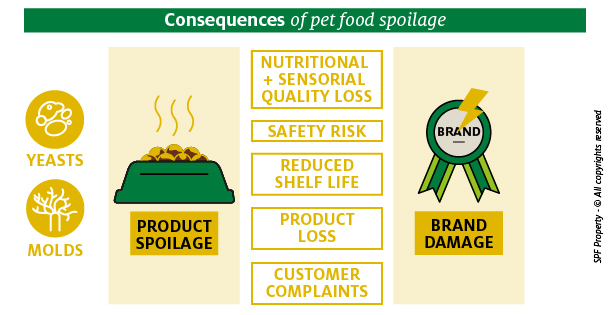
Controlling spoilage is therefore essential to maintain product integrity and meet pet parents’ expectations.
What are yeasts and molds
Yeasts and molds are fungi commonly found in the environment. Yeasts are unicellular organisms, while molds are filamentous fungi that reproduce through microscopic airborne spores. Mold spores are highly resilient and can survive drying, temperature changes, low water activity, and other environmental stresses over long periods of time.
Yeasts and molds require only small amounts of moisture and nutrients and can begin to grow quickly once favorable conditions are present, such as after pet food packaging is opened.
Why pet food is particularly susceptible to yeasts and molds
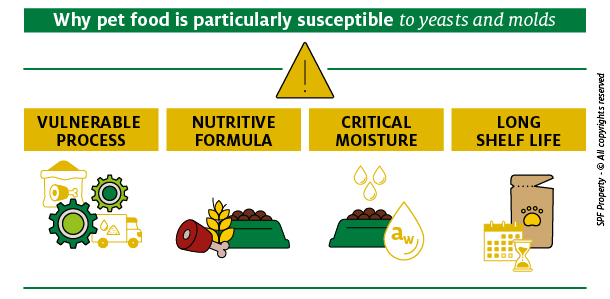
Several factors make pet food highly susceptible to spoilage.
Vulnerable process
Yeasts and molds are everywhere, even in the air. Across a pet food’s life, they can be found in raw materials, during processing, cooling, transport and in storage facilities. This increases the opportunities for contamination.
Nutritive formula
Pet food is rich in nutrients that provide ideal fuel for yeasts and molds growth.
Starch-based plant ingredients, along with proteins and amino acids sources create a nutritive base that yeasts and molds can readily exploit so any contamination can quickly turn into spoilage when conditions allow.
Critical moisture
Pet food typically has relatively high moisture levels, and therefore relatively high water activity (aw), which can promote the growth of molds and yeasts.
Semi‑moist products, due to their higher moisture content, create particularly favorable conditions for the development of a wide range of these microorganisms.
Dry kibble, despite having lower moisture and aw, can still be affected by certain molds capable of growing under drier conditions.
Moreover, humidity fluctuations such as condensation can temporarily raise moisture levels and create environments where yeasts and molds can begin to thrive.
Long shelf life
Pet food often has long storage periods – often up to 18 months – increasing the likelihood of microbial contamination.
Once the packaging has been opened, pet food is exposed to air, humidity, and handling, all of which can accelerate spoilage. If bags are not properly handled and resealed, moisture uptake can raise water activity, allowing yeasts and molds to grow more easily.
What yeasts and molds do to pet food
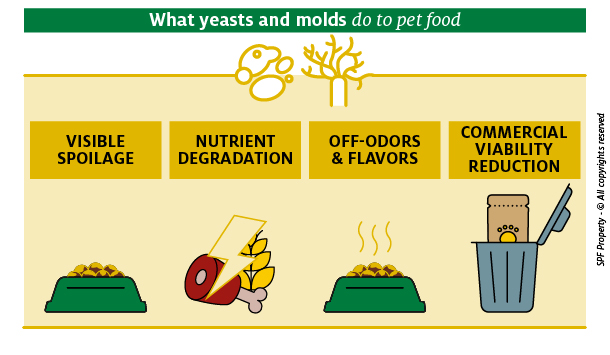
Yeasts and molds activity alters the physical, chemical, nutritional and sensory properties of the product, ultimately compromising its stability and commercial value.
Visible spoilage
Mold growth is the main visible sign of spoilage. Discoloration, powdery spots, or fuzzy patches can appear on the surface of kibble or treats and gradually spread throughout the bag.
Nutrient degradation
Yeasts and molds consume nutrients in the food matrix as substrates for growth. Over time, through enzymatic activity, they break down carbohydrates, lipids, and proteins, resulting in the progressive loss of nutritional value, undermining the formulation’s intended benefits.
Off‑flavors and odors generation
The by-products from fungal growth can create volatile compounds, leading to off-flavors and odors, such as:
- sour or fermented notes (common with yeasts contamination)
- musty, earthy, or moldy odors (typical of filamentous fungi)
- rancid notes associated with fat oxidation (typical of yeasts contamination)
Pets, and their parents, are sensitive to these changes that can affect palatability and lead to decreased acceptance.
Commercial viability reduction
The “Best By” date printed on the bag is a promise of quality. When yeasts and molds begin to grow, that shelf-life promise is no longer upheld.
This invariably leads to customer complaints, product returns, potential recalls, and discarded products, each carrying financial and reputational costs.
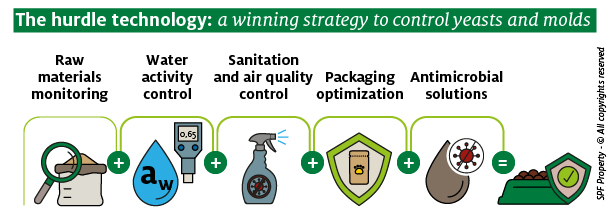
The hurdle technology: a winning strategy to control yeasts and molds
Once yeasts and molds begin to grow, there is no good way to reverse the process. That is why preventive control, rather than corrective action, is the most effective approach.
Hurdle technology is a proactive strategy that combines good manufacturing practices, environmental controls, and careful ingredient management to establish multiple, complementary barriers against yeasts and molds growth. Some of the most effective hurdles include:
1. Raw materials monitoring
Ingredients such as grains, proteins, fibers, and fats can carry microbial loads into the production process.
- Regular testing and supplier verification help ensure that incoming materials meet quality standards.
2. Water activity control
Water activity (aw) is one of the most critical factors in microbial growth.
- Keeping aw below certain threshold levels – <0.70-0.80 for most molds and <0.85 for many yeasts – significantly reduces the risk of microbial proliferation.
3. Environmental sanitation and air quality control
If Good Manufacturing Practices (GMP) are not followed and proper sanitization is not performed, airborne contaminants can settle on exposed surfaces of equipment.
- Frequent cleaning and maintenance of processing equipment, conveyors, and storage areas help prevent cross‑contamination. Airflow and humidity control also play a key role in limiting spore spread.
4. Packaging optimization
When packaging is not properly sealed, water activity can increase favoring product contamination
- Barrier materials, oxygen control, and proper sealing help maintain product stability throughout shelf life.
5. Use of antimicrobial solutions
While physical, environmental, and formulation-based controls are essential for microbial stability, they are often not enough on their own.
- Preservation systems, acting as chemical hurdles, inhibit yeasts and molds before they can cause spoilage. Antimicrobials help maintain freshness, protect nutritional integrity, and support a longer shelf-life. They work by creating conditions that are unfavorable for microbial growth, offering an added barrier of protection that complements existing quality programs.
Antimicrobials inhibit or slow the proliferation of yeasts and molds by affecting key cellular parameters, including membrane integrity and metabolic pathways.
The value of a proactive preservation strategy
In today’s competitive pet food market, manufacturers must deliver products that are safe, stable, and consistent. At the same time, consumers demand transparency, cleaner labeling, and predictable product performance, while retailers expect long shelf-life with minimal risk of spoilage.
A proactive protection strategy such as Hurdle strategy is key to supporting product integrity and meeting customer expectations. It helps manufacturers:
- Extend shelf life by inhibiting microbial activity before it starts.
- Protect product quality across long distribution chains.
- Maintain compliance with regulatory and retailer standards.
Preventing microbial growth is not just a safety measure – it is a strategic advantage.
Take-home points


* required fields